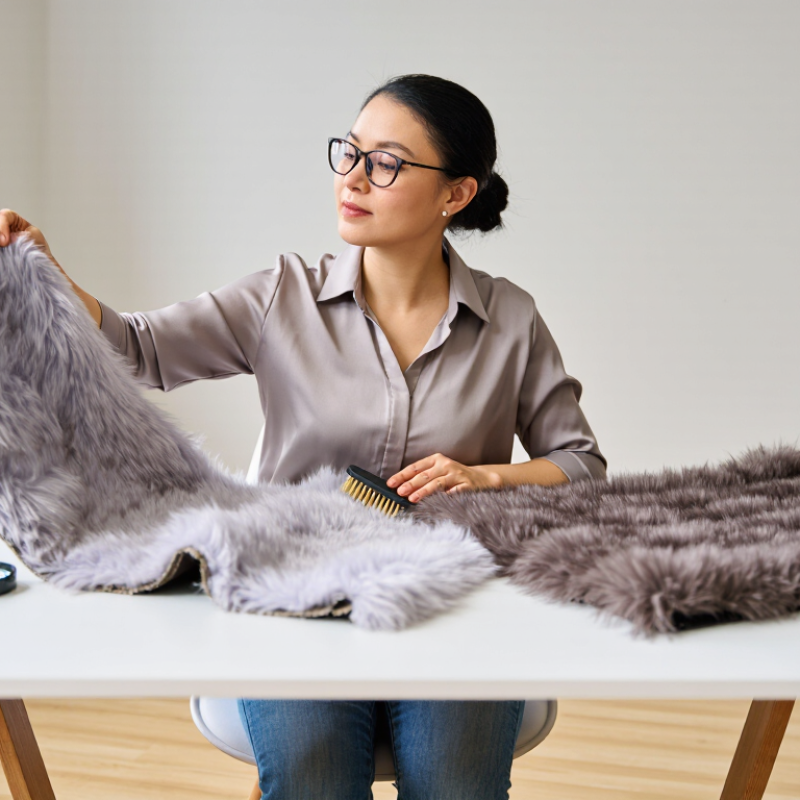
Choosing convincing faux fur takes more than a quick glance. The surface may look soft in a product photo, yet feel stiff or shed heavily in your hands. This guide explains how to identify high-quality faux fur through simple, repeatable checks. Examine the pile in natural light. Run your fingers against its direction. Look for even density, flexible fibers, and a backing that feels secure rather than papery. A gentle shake can reveal loose strands. Small details matter.
A textile expert’s verified perspective can make these checks more useful. No source material was provided for this request, so I cannot responsibly attribute a quotation to a named expert. Add a verified expert’s name and exact words here: “[Insert sourced quotation about assessing faux fur quality].” Confirm the quotation against a reliable publication or interview before using it. That step protects readers from invented credentials and misleading claims.
Quality is not always obvious. Two fabrics can share a similar shine but differ in softness, construction, and durability. This guide offers a practical starting point, not a laboratory certification. Compare samples when possible. Check the label, inspect seams, and note how the pile recovers after brushing. Trust your senses, but question first impressions. A little skepticism helps.
Verify Fiber Composition Using ISO 1833 Quantitative Analysis
2026 Best Guide to Identifying High Quality Faux Fur
Verify Fiber Composition Using ISO 1833 Quantitative Analysis
A plush surface can feel convincing, but touch cannot reveal its fiber blend. ISO 1833 sets out quantitative chemical methods for analyzing textile mixtures. These methods estimate fiber proportions by mass, using procedures suited to particular fiber combinations. That distinction matters. A percentage result describes composition, not softness, durability, or overall quality.
For faux fur, ask the laboratory to test a representative sample of the pile. The backing may use different fibers, so it should be sampled and reported separately when relevant. A tiny clipping from one spot may not reflect the whole fabric. Annoying, but important. Tell the lab whether the sample includes pile, backing, or both, and request the applicable ISO 1833 method.
Read the report for the method used, sample description, measured percentages, and any stated uncertainty. Ask how the lab handled coatings, finishes, or fibers that could interfere with chemical separation. Results can depend on the blend and the method’s scope. A qualified textile laboratory can explain those limits. I would not treat a neat percentage as proof of quality; I have to remind myself that testing answers a narrow question. Use it alongside checks of pile shedding, backing strength, and consistency across the fabric.
2026 Guide: Identifying Faux Fur Fiber Composition
Typical polymer densities provide a useful reference when comparing common faux-fur fibers. Density alone cannot identify a fiber or determine product quality.
How to use this chart: The values are typical reference densities in g/cm³; actual values may vary with polymer grade and processing. ISO 1833 specifies quantitative chemical-analysis methods for determining fiber composition in mixtures. Use an applicable ISO 1833 method to verify composition rather than treating density as a substitute for testing.
Measure Pile Height, Density, and Backing Stability
Measure pile height from the backing to the tips, not from the fabric’s full thickness. Check several areas with a ruler; uneven patches can reveal inconsistent finishing. Longer fibers may feel plush, but they can mat more easily. Density matters too. Part the pile with your fingers and look for exposed backing. A small amount of backing may show at a sharp part, so compare the fabric across several spots rather than judging one glimpse. Small gaps matter.
Check the backing gently. Stretch a small section, release it, then brush the pile in different directions. The base should recover without obvious rippling, loose tufts, or widening gaps. A light tug can reveal shedding, but this is only a screening check, not a laboratory test. Textile Exchange’s Materials Market Report 2024 estimates that polyester made up 57% of global fiber production in 2023. That figure describes the wider fiber market, not faux-fur quality; it does underline why backing and construction deserve close inspection. Feel is useful, but it can mislead. A soft sample may still have a weak base, and brief checks cannot predict years of wear.
Assess Abrasion Resistance with ISO 12947 Martindale Testing
To judge faux fur, separate fabric breakdown from pile appearance. ISO 12947-2:2016 specifies a Martindale method for determining when a textile specimen breaks down through abrasion. The sample rubs against a standard abrasive in repeated, multidirectional movements. Record the cycle count and the exact failure point, such as a hole or broken yarns. Pile flattening matters too, but it is a different observation; ISO 12947-4 addresses appearance change. Small details matter. Keep the backing, pile direction, conditioning, and test settings consistent when comparing samples.
A high cycle count is not a universal quality grade. Test results depend on construction and agreed test conditions, so compare like with like. Textile Exchange’s Materials Market Report 2024 estimates polyester made up 57% of global fiber production in 2023. That figure describes the wider fiber market, not faux-fur durability; it helps explain why synthetic textiles vary so much in structure. Request the laboratory report, including specimen count and individual results, rather than relying on a single headline number. A neat number can still mislead. I would not treat one test as a verdict: after abrasion, inspect whether the pile has thinned, matted, or exposed the backing.
2026 Best Guide to Identifying High Quality Faux Fur - Assess Abrasion Resistance with ISO 12947 Martindale Testing
Illustrative comparison only: The specimen descriptions and results below are hypothetical sample data, not laboratory findings or ISO acceptance limits. ISO 12947 specifies Martindale abrasion test procedures; the test report should identify the applicable part, agreed test conditions, endpoint, and any deviations.
| Sample |
Illustrative construction |
Pile height (mm) |
Martindale cycles to specimen breakdown* |
Appearance at 20,000 cycles |
Pile retention after test (%)† |
Practical reading |
| A |
Dense polyester pile; knitted polyester ground |
12 |
40,000 (test stop; no breakdown observed) |
Mild pile matting; ground not exposed |
92 |
Strongest result in this illustrative set; confirm handle and appearance after care testing. |
| B |
Medium-density acrylic/polyester pile; woven ground |
18 |
30,000 (test stop; no breakdown observed) |
Visible flattening; limited fiber shedding |
84 |
Moderate-to-good illustrative result; assess pile recovery and shedding for intended use. |
| C |
Long polyester pile; lightweight knitted ground |
25 |
20,000 (test stop; no breakdown observed) |
Pronounced matting; localized pile loss |
71 |
Appearance changed noticeably; consider shorter pile or more robust construction for high-contact use. |
| D |
Low-density polyester pile; lightweight backing |
10 |
12,000 (breakdown observed) |
Ground yarn visible in the worn area |
58 |
Lowest illustrative result; inspect backing integrity and pile anchorage. |
How to use the comparison
* “Cycles to specimen breakdown” is an example result field, not a universal pass/fail threshold. A test stopped before breakdown should be reported as “no breakdown observed at” the stated cycle count, rather than as an exact failure life.
† Pile retention is shown as a hypothetical supplementary measurement. It is not, by itself, an ISO 12947 rating; the measurement method and calculation should be defined and reported by the testing laboratory.
For meaningful comparisons, test specimens using the same documented setup and conditioning, and evaluate pile appearance, shedding, backing damage, and specimen breakdown separately. Faux-fur pile can mat or change appearance before the ground fabric breaks, so abrasion cycles alone do not describe every aspect of service performance.
Check Washing Colorfastness Against ISO 105-C06
2026 Best Guide to Identifying High Quality Faux Fur
Check Washing Colorfastness Against ISO 105-C06
Faux fur often uses polyester pile, so washing can expose weak dyeing. Textile Exchange’s Materials Market Report 2024 estimates polyester made up 57% of global fiber production in 2023. That market figure is context, not proof of a fabric’s quality. Ask for a test report covering the actual faux-fur fabric, not merely its fiber type.
ISO 105-C06 evaluates colorfastness during domestic or commercial laundering. Test conditions vary, so check the method, temperature, detergent, and number of wash cycles. Look for separate ratings for color change and staining on adjacent fabric, commonly assessed with a gray scale from 1 to 5; higher scores indicate better performance. Match the test conditions to the garment’s care instructions. A strong score under a gentle cycle may not predict results after hotter or repeated washing.
Tips: Request the dated laboratory report and confirm the sample matches the pile, backing, and color you plan to buy. After testing, inspect the pile under daylight for dye transfer, dull patches, or uneven color. Small details matter. I would still compare several samples: one test cannot capture every real-world wash, and dense pile can hide subtle changes.
Conclusion
This guide explains how to identify high-quality faux fur through practical checks and measurable tests. Start by verifying the fiber composition with ISO 1833 quantitative analysis, then examine pile height, density, and backing stability. A consistent pile with secure fibers and a backing that holds its shape can indicate careful construction. Abrasion resistance can be assessed using ISO 12947 Martindale testing, while ISO 105-C06 washing tests help determine whether color is likely to remain stable after laundering.
Quality checks should also include observing shedding, testing seam strength, and comparing care-label instructions with the material’s expected needs. Together, these steps offer a clearer basis for evaluating durability, appearance, and maintenance requirements. Rather than relying on softness alone, use these checks to understand how to identify high-quality faux fur and choose a fabric suited to its intended use.

 Harbor Textiles