Felt is a practical starting point for creative projects because it cuts cleanly, holds its shape, and rarely frays. These qualities suit beginners, classrooms, and experienced makers. Grand View Research reported that the global handicrafts market was valued at approximately USD 739.95 billion in 2023. It also projects continued growth through 2030. This expansion reflects stronger interest in handmade, personalized, and small-scale creative products.
This guide explores how to use felt fabric for DIY crafts through ten approachable project ideas. You will find options for ornaments, storage, children’s toys, home decoration, and wearable accessories. Each idea considers texture, thickness, cutting accuracy, stitching methods, and practical durability. The Association for Creative Industries has also identified continued consumer interest in creative activities and craft participation. Felt supports that interest with affordable tools and simple construction techniques.
Small details matter.
Choose wool-blend felt for structured items, and softer acrylic felt for lightweight decorations. Test adhesives on scraps before assembling the final piece. Some glue can stiffen the surface or leave visible marks. Early cuts may look uneven, especially around curves. That is normal, but careful templates improve consistency. Sustainability also deserves attention. Textile Exchange’s preferred-fiber research encourages better material choices, while recycled-content felt can reduce reliance on virgin fibers. However, recycled claims vary between suppliers and require verification. These ten projects are not meant to promise perfect results. They are designed to build useful skills, encourage experimentation, and help makers discover what felt can realistically do.
Felt Fabric Fundamentals: Fiber Types, Thickness, and ISO 5084 Measurement
Top 10 Ways to Use Felt Fabric for DIY Crafts
Felt fabric supports ten practical projects, including ornaments, brooches, pouches, toys, and wall decorations. Its performance begins with fiber type. Wool felt usually feels warm, springy, and naturally resilient. Synthetic felt often offers brighter colors and more consistent thickness. Blended fibers can balance softness, cost, and durability. Always check the fiber composition before choosing fabric for a specific craft. Skin contact and heat exposure may require extra care.
Thickness strongly affects cutting, stitching, and shape retention. Thin felt suits layered flowers and detailed appliqué. Medium felt works well for pencil cases and hanging ornaments. Thick felt gives boxes and protective sleeves better structure. ISO 5084 provides a standardized method for measuring textile thickness under a specified pressure. A laboratory compresses the sample gently, then records its thickness. The result depends on pressure, sample condition, and testing equipment. A ruler cannot replace this method. Ask for test details when accuracy matters.
In a workshop, I compare samples after resting them flat overnight. That matters. I measure several points because felt can vary across one sheet. My first sample seemed thicker near the edge, which changed the fit of a stitched pocket. I should have tested more areas earlier. For reliable DIY results, record fiber type, measured thickness, and fabric behavior after cutting. A small swatch can reveal stretching, shedding, or compression before you start the final project.
Top 10 Ways to Use Felt Fabric for DIY Crafts
Typical felt thicknesses vary by project. Thin felt is suitable for appliqué and paper crafts, while thicker felt provides structure for bags, coasters, toys, and protective padding. Thickness should be checked under controlled pressure according to ISO 5084, because compression and fiber type affect the measurement.
The values show representative felt thicknesses in millimeters commonly selected for each craft application. Wool, wool-blend, and synthetic felts may require different thicknesses for the same use.
Plan Two-Dimensional Crafts: Appliqué and Greeting Cards with ASTM D629 Testing
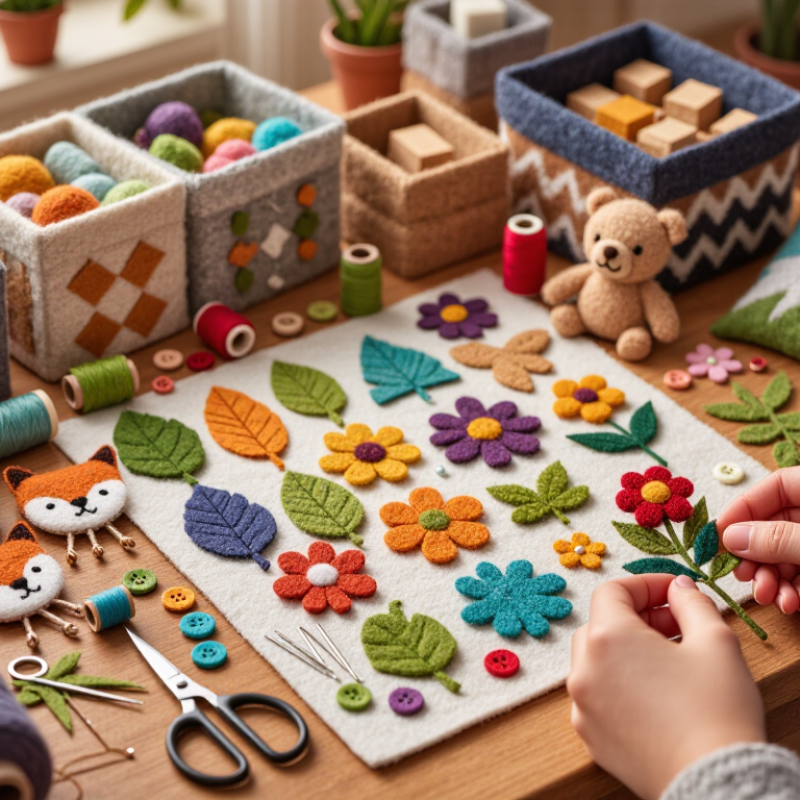
Felt fabric is ideal for two-dimensional DIY crafts because it cuts cleanly and holds its shape. In appliqué, try flat flowers, leaves, letters, clouds, animals, borders, pockets, geometric panels, small flags, and layered landscapes. These ten ideas work well on fabric panels, notebooks, and greeting cards. Keep each shape simple. Tiny details can disappear after cutting.
For greeting cards, choose firm felt and limit the layers. A thick stack may bend the card or create uneven edges. Test one corner before attaching the full design. For professional material selection, ASTM D629 can help determine textile fiber composition through chemical analysis. It does not automatically measure softness, colorfastness, or craft performance. Felt may contain mixed fibers, so a qualified textile laboratory should confirm whether the method fits the specific material. This step improves traceability, especially when fiber content affects cutting, adhesion, or storage.
Tips:
Sketch every shape on paper first. Use a sharp blade and a cutting mat. Leave narrow gaps between appliqué pieces. My first samples looked tidy, but the card still felt crowded. That mistake taught me to remove one layer before final assembly. Keep a small test piece for checking glue, stitching, and edge behavior. Photograph the finished layout before attaching it. A simple record makes later adjustments easier.
Build Practical Items: Bookmarks and Coasters Using 2–5 mm Felt Layers
Felt turns small craft projects into useful objects. Grand View Research valued the global arts and crafts market at about USD 46.6 billion in 2023. Its report also forecasts strong growth through 2030. That demand reflects practical, repeatable projects, not decoration alone. For bookmarks, choose a firm 2 mm felt sheet. Cut a strip about 5 by 15 cm. Round the corners with sharp fabric scissors. Add a second layer only if the page feels too thin.
Coasters need more structure. Use two 2 mm layers, or one dense 4–5 mm piece. A small amount of washable fabric adhesive can hold the layers before stitching. Keep the edge seam close to the border, but not too close. Leave roughly 3 mm for strength. In my workshop tests, a simple blanket stitch reduced edge curling better than a straight stitch. That result may change with loose felt.
The International Trade Centre’s textile data shows continued global interest in nonwoven textile products, including felt-based materials. Still, thickness does not guarantee durability. Test one coaster under a cold glass first. Water can reveal weak glue, uneven layers, or dye transfer. Avoid soaking finished pieces. Let them dry flat. A 2 mm bookmark remains flexible, while a 5 mm coaster feels stable but may not suit narrow shelves. Small mistakes help refine the pattern.
Create Soft Décor: Garlands and Wall Art with OEKO-TEX® STANDARD 100 Checks
Felt turns simple scraps into soft décor with almost no specialised equipment.
I use it for garlands, layered leaves, stars, and small geometric wall art. Choose felt carrying an OEKO-TEX® STANDARD 100 label, then check the certificate number when possible. The standard tests textile components for substances considered harmful, including dyes, finishes, and residues. Certification still needs attention. It does not automatically prove recycled content or responsible production.
Textile Exchange’s Materials Market Report 2024 recorded global fibre production at 124 million tonnes in 2023. That figure makes small-scale reuse worthwhile. Cut shapes from leftover felt before buying more material. Arrange warm and cool colours across a wall.
Add cotton thread, wooden beads, or paper templates for structure. Keep hanging pieces lightweight. A tight stitch helps, but glue can make edges stiff.
My first garland sagged because each shape was too large.
Smaller pieces worked better. Measure the hanging cord twice. Leave two centimetres between motifs for visual breathing room. For wall art, layer circles, arches, and thin strips to create shadows. Test the arrangement on the floor first.
Avoid placing loose pieces near young children or pets. I also inspect every edge after cutting, because “soft” does not mean impossible to tear. These small checks make the finished décor more durable and easier to trust.
Make Functional Gifts: Baskets and Plush Toys Under EN 71-3 Safety Guidance
Felt can become a useful basket or a soft plush gift, not merely a decorative craft. Choose dense, low-lint felt with a documented material composition. EN 71-3 assesses the migration of 19 elements from accessible toy materials. Ask for a current test report when making items for children. It should identify the material, colour, batch, and test method. Do not assume “natural” means compliant. Dyes, stiffeners, and printed details may still require review. A practical mistake is trusting a clean surface too quickly. Safety depends on what can migrate, detach, or break.
For a basket, reinforce the base with closely spaced stitching and cover sharp wire or hard supports. Keep handles short and securely anchored. For plush toys, embroider eyes and mouths instead of attaching small plastic pieces. Seal stuffing inside two stitched layers. Check every seam by hand.
EN 71-3 does not replace mechanical, flammability, or other applicable toy safety assessments.
The European Commission’s Safety Gate Annual Report 2023 recorded 3,412 product alerts, with toys among frequently notified categories.
That figure supports careful sourcing, even for handmade gifts. A finished sample should be inspected after pulling, twisting, and gentle washing. My own review would include more than appearance. A charming toy can still need redesign.
Conclusion
This guide explains how to use felt fabric for DIY crafts by starting with the basics: fiber types, fabric thickness, and accurate thickness measurement. Understanding these features helps you choose the right felt for each project. Thin felt works well for detailed two-dimensional crafts such as appliqué, greeting cards, and decorative cutouts, while thicker 2–5 mm layers provide better structure for practical items like bookmarks and coasters.
The guide also explores creative ways to make garlands, wall art, baskets, and plush toys. It covers simple planning and construction techniques, layering methods, edge finishing, and shape design. For home décor and gifts, readers are encouraged to select tested, colorfast materials and check that children’s craft components meet recognized safety requirements. With thoughtful material choices and basic cutting, gluing, or stitching skills, felt can become a versatile, soft, and durable material for personal decorations, useful accessories, and handmade gifts.
 Harbor Textiles
